Articles & Case Studies
Why Clay Grew: GTM Workflow Integration
Clay’s appeal can be understood partly as making multi-tool GTM workflows accessible to smaller teams. This is an architectural interpretation, not a measured explanation of its growth.

· updated October 6, 2026
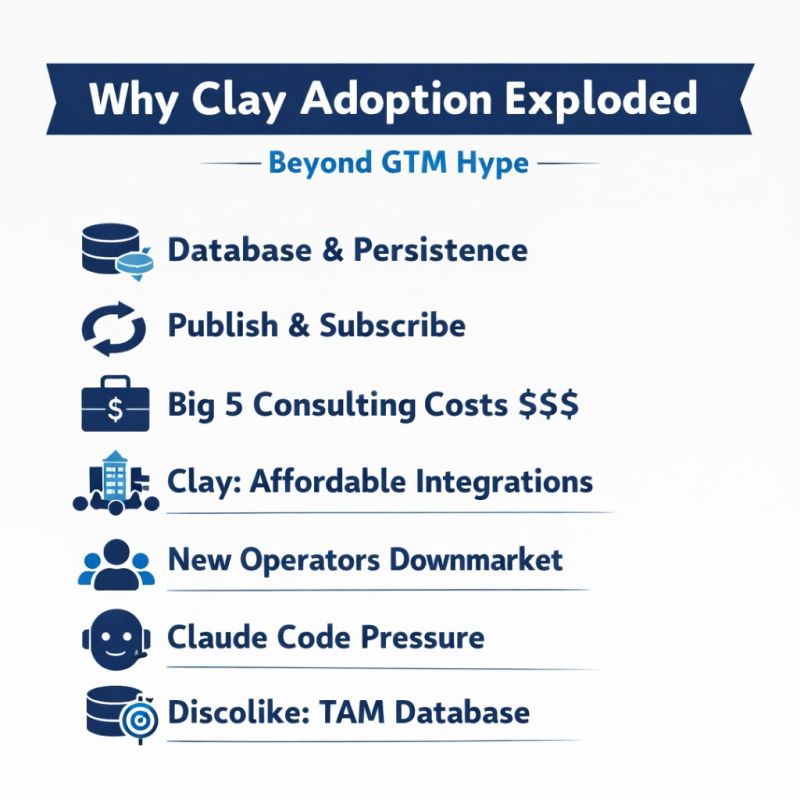
A GTM team may already have the tools it needs and still struggle to connect them. Company sourcing, enrichment, AI research, and CRM updates become separate steps with fragile handoffs.
My interpretation of Clay’s appeal is that it made much of this integration work accessible to operators who would otherwise need custom engineering.
The integration problem behind the interface
Large organizations have long used integration systems to move data and trigger work across applications. Smaller teams face similar coordination problems with fewer engineering resources.
A shared workflow interface can help an operator see the records, connect providers, and define what happens next. That reduces the distance between a campaign idea and a working process.
The broader architectural idea is coordination: a result from one tool becomes usable input for the next. Making that handoff easier can unlock workflows that were previously too expensive to maintain.
Why this matters to GTM teams
A sourcing result is useful only when the next step can consume it. Common identifiers, clear failure states, and usable outputs can matter as much as the individual provider’s capability.
The convenience of orchestration should still be evaluated separately from the quality and coverage of the data it connects.
How agent interfaces change the options
Agents using connected tools can help plan and execute exploratory workflows through conversation. That may reduce manual configuration for some tasks.
A production process still needs persistence, monitoring, predictable permissions, and a way to recover from partial failures. A successful one-off agent run is not the same as a maintained operational workflow.
Choose the workflow and data layers deliberately
Compare approaches on review effort, reproducibility, total cost, and the quality of accepted records. Keep your company identifiers and qualification rules portable when possible.
DiscoLike supplies company discovery and research through API and MCP, so you can use the data layer inside the workflow environment that fits your team.
Related posts: