Articles & Case Studies
3 GTM Data Problems to Solve Before Automation
Inbound domain cleanup, customer segmentation, and company-name matching are recurring GTM data problems. Solving them well reduces the custom logic needed in downstream automations.

· updated October 6, 2026
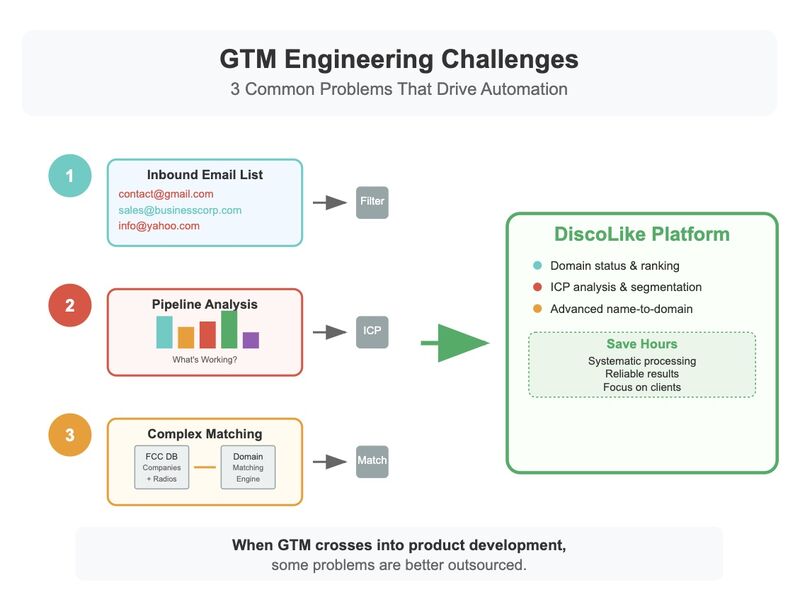
Three requests regularly send GTM engineers into a new Clay table or n8n workflow: clean an inbound list, learn from a client’s pipeline, or identify companies in an unusual source dataset.
Each needs a different data operation. Treating all three as a generic AI prompt hides the checks that make the output usable.
1. Clean and rank inbound business domains
An inbound list can contain personal email providers, duplicate domains, redirects, and inactive sites. Identify those states before attempting ICP scoring.
DiscoLike can append domain status and company information. Review redirects and organization identity so the same company does not appear several times under different domains.
Rank the remaining business accounts against a defined ICP. Keep “unresolved” distinct from “not a business” when the evidence is insufficient.
2. Segment the pipeline by business characteristics
Export account domains with pipeline stages or outcomes. Segment companies, then inspect the distribution of closed-won and closed-lost accounts within each group.
A high win rate in a tiny segment is a hypothesis, not guaranteed product-market fit. Review sample size, sales effort, deal value, and retention before reallocating the campaign budget.
Use the stronger segments as starting points for new lookalike searches.
3. Match company names to domains
Government, trade, and licensing datasets often contain organization names without useful website fields. Matching them requires handling shared names, trading names, locations, and parent organizations.
Pass the available location and identity context to name-to-domain matching. Manually review ambiguous matches before researching the website or treating the company as a qualified account.
Build automation around accepted records
Once these operations are reliable, the workflow can focus on campaign-specific research and routing. Measure errors at each handoff so a bad domain match does not masquerade as a qualification problem.
Explore DiscoLike’s API for these data operations, then test with examples your team can verify.
Related posts: