Product Updates
DiscoGen BYOK: Model and Search API Keys
DiscoGen BYOK lets you supply separate model and search API keys and pay those providers directly. Company context and optional web search support different research tasks.

· updated October 6, 2026
Bring your own key, or BYOK, gives you direct control over the providers behind an AI research workflow. In DiscoGen, that applies to both the model and the search service.
This matters because two runs of the same prompt can have different costs and results depending on the model, retrieved sources, and search depth.
Separate the costs before comparing tools
A company research workflow has several cost components:
| Component | What to account for |
|---|---|
| DiscoLike subscription and records | Your plan and data usage |
| Model usage | Input, output, and other provider-billed usage |
| Search usage | Queries or requests charged by the search provider |
| Review and retries | Failed runs and manual checks |
DiscoLike does not add a provider markup to calls made with your own model and search keys. Free orchestration does not mean the entire workflow is free.
Use homepage context before adding search
Discover company records include homepage text at no additional charge for that text. DiscoGen can use it with the company profile to answer questions about products, customers, and positioning.
If the task is to qualify what the company says on its homepage, that context may be enough. Questions about recent funding, external reviews, or leadership changes may require web search.
Keeping those tasks separate makes costs and errors easier to understand.
Choose providers using a representative sample
DiscoGen supports configurable model and search providers, including workflows with search services such as Serper. Check the available configuration for the provider you want to use.
Run the same sample through your shortlisted options. Compare verified answers, missing evidence, latency, and total provider charges. A more expensive model may be worthwhile if it substantially reduces review work; a simpler model may be sufficient for a bounded extraction task.
At launch, our selected workloads cost a few dollars per 1,000 records. Budget your own workflow from a measured sample, accounting for context length, searches, retries, and current provider pricing.
Run research through API or MCP
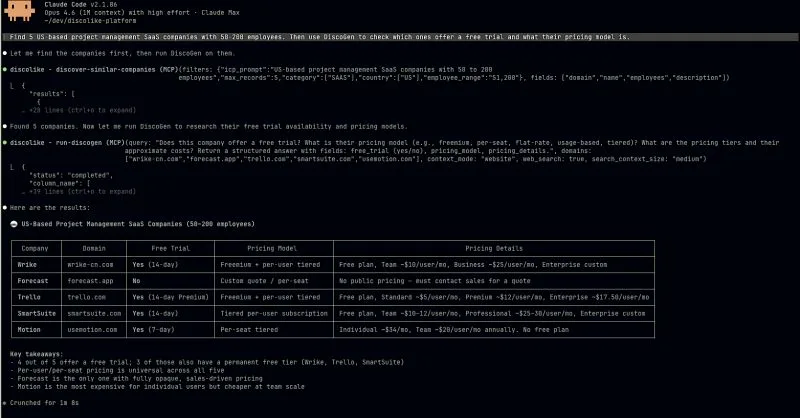
DiscoGen is available through API and MCP as well as the product workflow. You can call it from an agent or incorporate it into a tool such as n8n.
For large jobs, let the research service process company records and return structured results. Keep the agent conversation focused on planning, reviewing examples, and deciding what to change.
Before scaling the job
Define the output fields, retain evidence, set a spend budget, and decide how unresolved records should be handled. Measure cost per accepted answer after validation.
Review current pricing and use a company list you know well for your first provider comparison.
Related posts: