Articles & Case Studies
Waterfall Enrichment: Coverage and Data Quality
Waterfall enrichment queries providers in sequence to fill missing data. It adds value when later sources contribute verified information, but overlapping or stale sources can add cost and errors.

· updated October 6, 2026
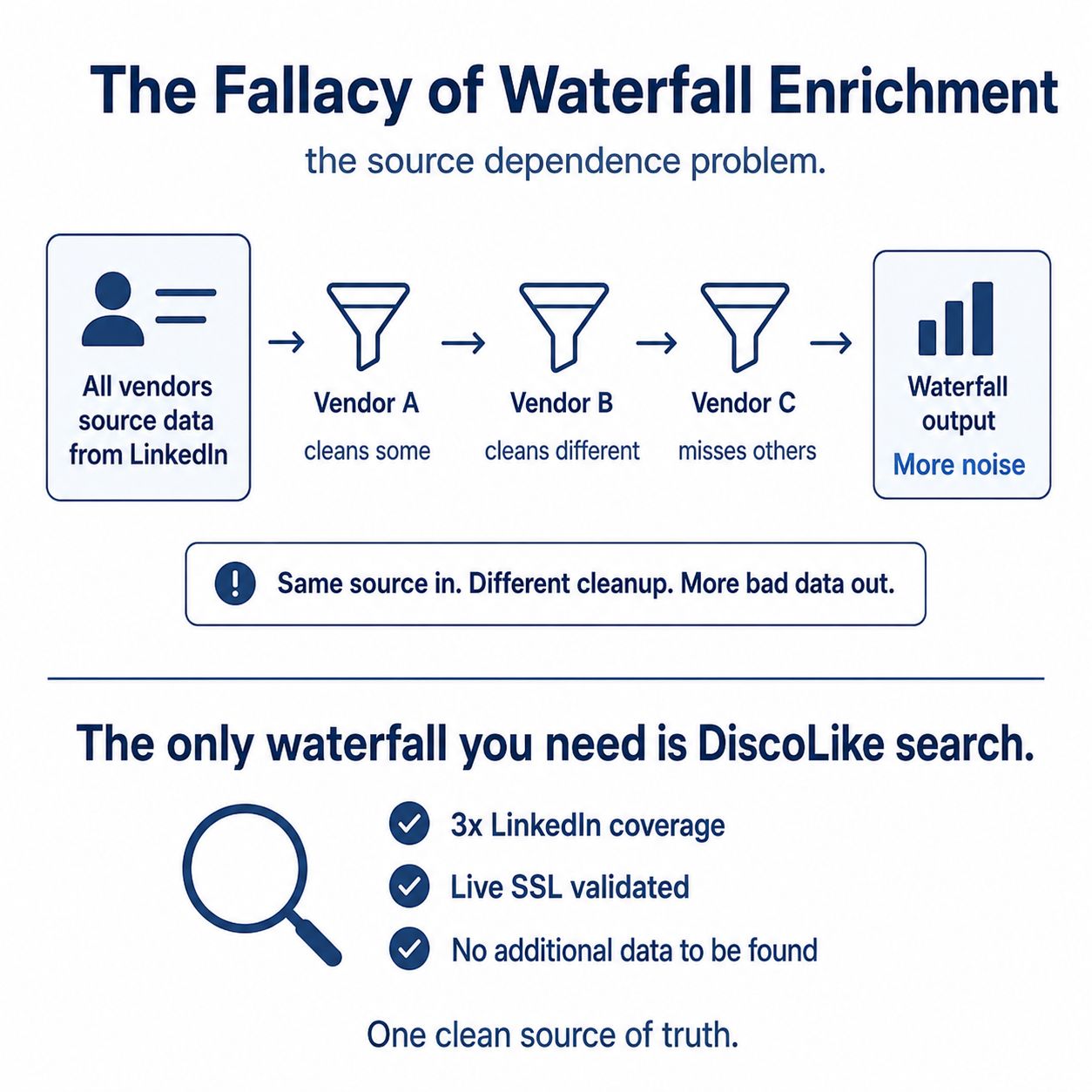
Waterfall enrichment moves to another provider when the first one cannot fill a field. It can increase coverage, but a higher fill rate does not automatically mean better data.
The useful question is what the next source adds after validation.
Why source overlap matters
Providers may share some underlying datasets, use different collection methods, or refresh records on different schedules. Overlap does not mean their data is identical, but it limits how much genuinely new information a sequence can add.
Ask about provenance and refresh methods. Do not assume every provider is independent, or that every provider buys exactly the same source.
A missing value may have several meanings
A provider may have no record, lack confidence, or have removed an old value. A later provider may contribute a valid update or reintroduce stale information.
For example, a contact who left the company may be absent from one source and present in another. Filling the field is useful only if the affiliation is still correct.
Preserve which provider supplied each value and when it was observed where possible.
Measure verified incremental coverage
For each step in the waterfall, track:
- New values returned for previously unresolved records.
- Values accepted after the same validation process.
- Conflicts with existing data and stale affiliations.
- Total cost per accepted new value.
This reveals whether later stages contribute enough reliable information to justify their cost. Run the comparison by vertical and field; a source may be strong for one audience and weak for another.
Company discovery is a separate problem
A contact waterfall can enrich only the accounts you supply. If your company list misses a relevant market segment, adding contact providers will not repair that coverage gap.
DiscoLike uses business website content and network signals for company discovery, then offers contact search and ContaGen for additional research. These are complementary stages, each with its own validation needs.
Network signals do not certify business legitimacy. A domain-validated certificate establishes domain control for issuance, not the quality of the company behind it. See Let’s Encrypt’s explanation.
Keep the sources that earn their place
Use several providers when they add verified information you need. Remove a stage when its accepted incremental yield no longer justifies its cost or complexity.
Audit an account sample with DiscoLike and compare the contribution after qualification, rather than comparing fill rates alone.
Related posts: