Articles & Case Studies
Outcome Learning Models for SaaS Products
An outcome learning model uses patterns from user workflows and observed results to improve future guidance. DiscoLike applies this approach to ICP search configuration.

· updated October 6, 2026
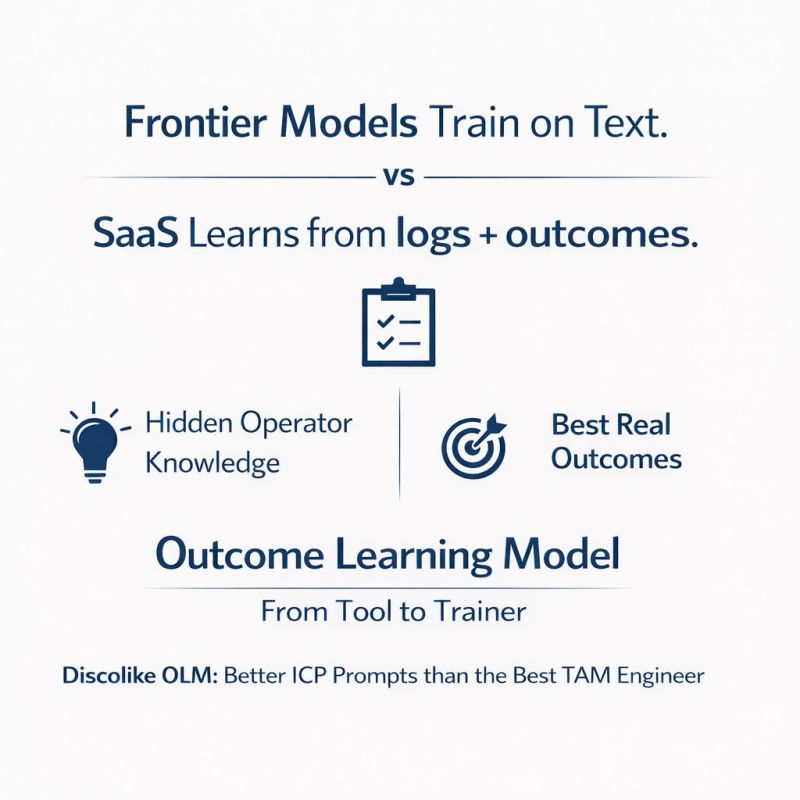
A software interface is easier to reproduce than the experience accumulated by customers using it. For a SaaS product, one source of differentiation is learning which workflows help users reach useful results.
At DiscoLike, we call this an Outcome Learning Model: a system that analyzes operator choices and their associated outcomes, then uses those patterns to guide future work. This is our name for the approach, not a universal technical standard.
What the model learns from
A GTM engineer refining an account search makes many decisions that never appear in a playbook. They change the ICP wording, add a seed domain, remove a restrictive phrase, or split a market into smaller segments.
A saved search and exported list preserve part of that work. Across many searches, those records can reveal useful patterns in how experienced users approach different markets.
The learning opportunity is the relationship between the task, the choices, and the result. Raw event volume alone does not establish quality.
DiscoLike’s query assistant example
We analyzed thousands of saved and exported TAM searches from hundreds of GTM teams. The material included ICP descriptions, representative domains, phrase matches, and industry configurations.
Claude Code helped extract patterns from that corpus. Those patterns informed the assistant that turns a short customer description into a proposed search configuration.
The AI TAM Query Assistant for ICP Search article explains the resulting workflow. Users still review the plan and sample the accounts before expanding the search.
Define what counts as an outcome
An export means an operator found a list worth using. It does not prove the list converted, that every company qualified, or that the campaign generated revenue.
Keep those levels distinct:
| Observed event | What it supports |
|---|---|
| Search saved | The operator wanted to retain the configuration |
| List exported | The operator chose to use the results |
| Accounts validated | Records passed a defined review |
| Campaign or sales outcome | Downstream performance, when measured and attributable |
A product should learn from the strongest relevant evidence it actually has. Calling every click a business outcome inflates the claim and can teach the wrong behavior.
Why the history can be valuable
A competitor can reproduce forms and API calls without reproducing your customer history. Domain-specific examples may give your product better starting assumptions for recurring tasks.
That advantage depends on the quality, diversity, and permitted use of the data. Biased feedback can reinforce a narrow view of the market. Changed customer behavior can make old patterns less useful.
Evaluate the guidance, not just the model
Compare assisted and unassisted workflows on the same tasks. Review qualified results, time to an acceptable query, and the frequency of corrections. Keep representative cases outside the examples used to develop the guidance.
Expose the query plan so users can challenge assumptions. DiscoLike MCP: Refine Your ICP Query Plan describes how that review can happen inside an agent workflow.
Try DiscoLike with a search you already know well and judge whether the assistant improves the result or reduces the work.
Related posts: