Articles & Case Studies
Hybrid AI Search for Company Discovery
Hybrid company search combines semantic retrieval with keyword or phrase matching. The query design determines how business meaning, exact evidence, and hard filters interact.

· updated October 6, 2026
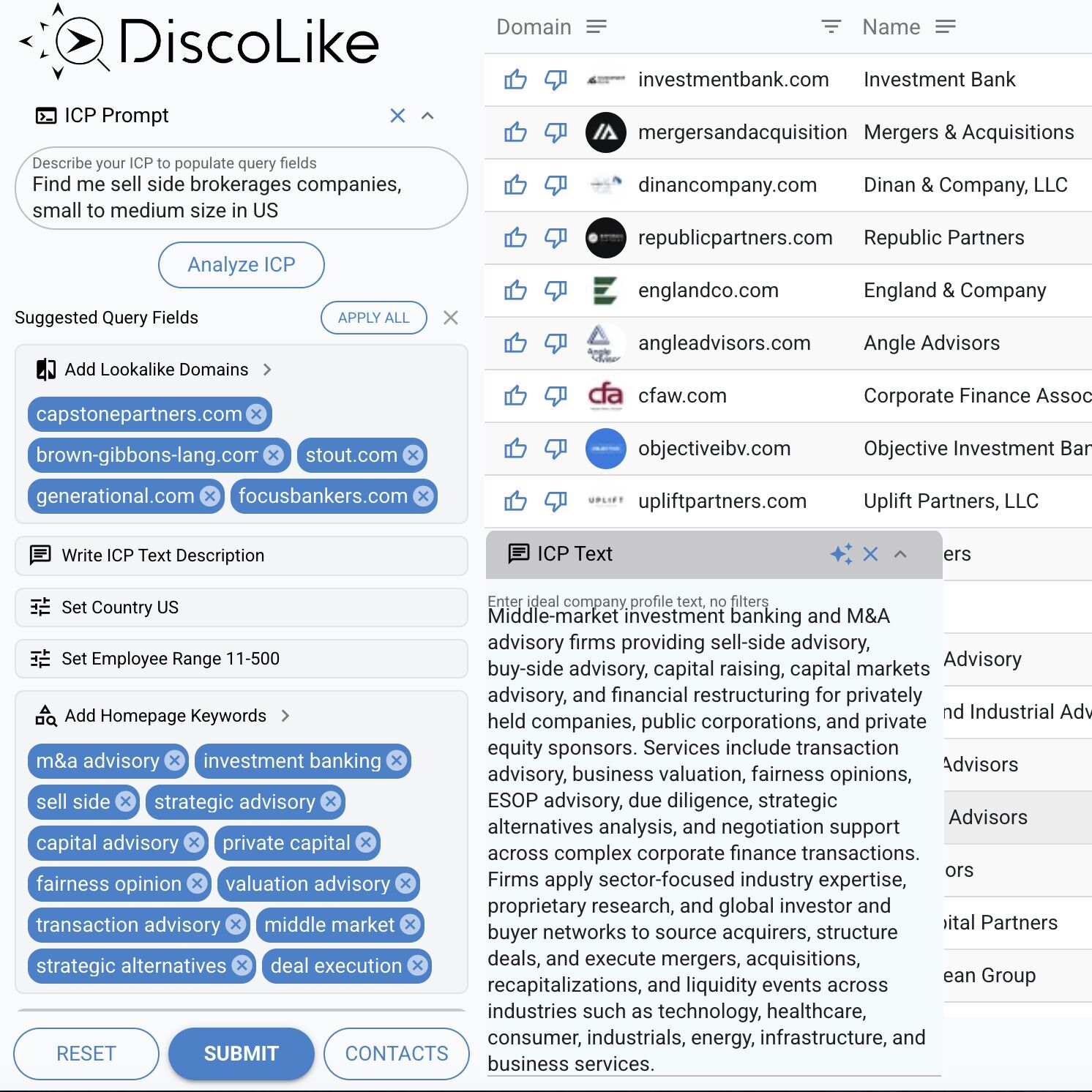
For company discovery, “AI search” can mean several different things: generating search suggestions, retrieving similar companies, or researching an account with web sources.
Hybrid retrieval combines two useful approaches to the discovery step: semantic similarity and lexical matching. It retrieves existing records rather than asking a model to invent an account list.
What vector search contributes
Vector search represents text as embeddings and compares those representations to retrieve related meanings. A company can match an ICP description even when its website uses different terminology.
For example, a query for software supporting outpatient clinic operations may retrieve businesses describing scheduling, patient communications, or practice management.
Some results may be adjacent companies with similar language. Semantic similarity needs qualification against the business requirement.
What keywords and phrases contribute
Lexical search looks for wording in the indexed material. A required phrase can narrow the candidates to those mentioning a particular product, certification, or service.
Hybrid systems differ in how they combine scores and filters. In a company-search workflow, be explicit about which terms are mandatory and which simply help rank results.
An exact phrase can verify that the words appear. It cannot, without context, prove a current certification or vendor relationship.
Why the ICP description matters
“B2B SaaS companies” leaves many business models in scope. “Software vendors selling appointment scheduling to independent clinics” expresses a more specific activity and buyer.
Add geography and size requirements through the appropriate filters. Use several representative domains to clarify the intended segment and avoid mixing unrelated customers into one lookalike search.
The search method is only part of the solution. Query wording and source coverage determine what the method has to work with.
How DiscoLike helps construct the query
DiscoLike’s query assistant uses patterns from prior customer searches to propose ICP text, phrase matches, and search parameters. The Outcome Learning Models for SaaS Products article describes that approach.
Inspect the proposed configuration against your client’s requirements. Patterns from past searches provide a starting point; your campaign supplies the criteria for accepting it.
Refine using accepted and rejected examples
Review a sample and label each account as a fit, mismatch, or unresolved. Change one major part of the query at a time so you can understand the effect.
If consultants dominate a product-vendor search, clarify the business model. If a required phrase removes known customers, check whether they use different wording or describe the capability on another page.
Store the query and review decisions. Counts and rankings can change when the index or configuration changes, so repeatability requires keeping that context.
Choose the next step based on the evidence
Use search to identify candidates, then research requirements the index cannot answer. Validate and deduplicate before exporting the campaign list.
Try hybrid search in DiscoLike with one familiar ICP and compare the accepted results with a keyword-only search.
Related posts: