Articles & Case Studies
Why AI Prompts Break GTM Automations
GTM prompts can vary because of model behavior, changing sources, and ambiguous instructions. Use structured retrieval and explicit checks for decisions that must be repeatable.

· updated October 6, 2026
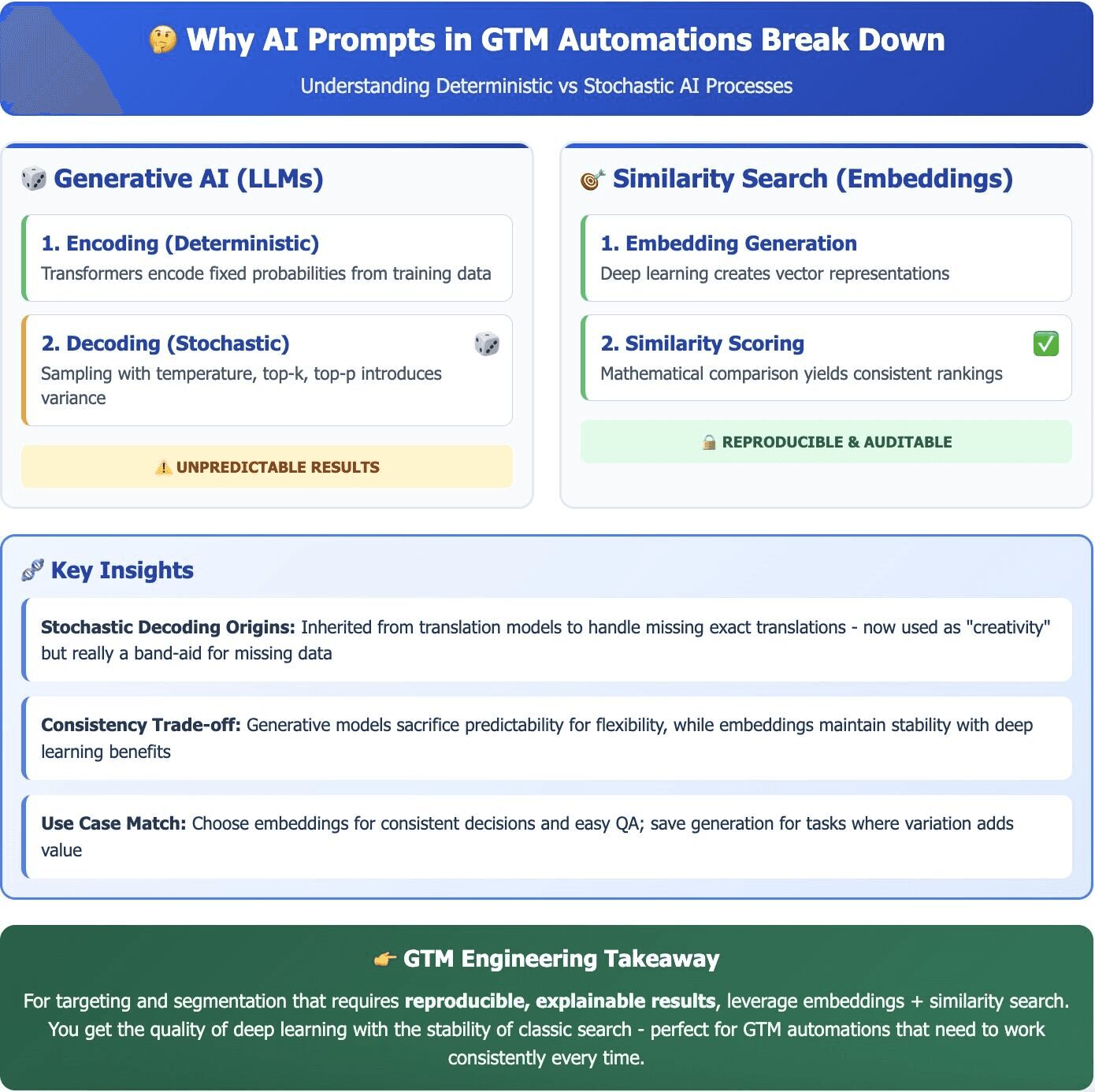
The same qualification prompt can produce different answers across runs. In a GTM automation, that can move an account between segments or change whether it reaches a salesperson.
The cause may be generation settings, a model update, different source material, or an ambiguous definition of fit. Treating every inconsistency as a prompting problem makes debugging harder.
Separate the search from the generated answer
Retrieval selects existing records. Generation produces text from the available context. Those operations have different failure modes.
DiscoLike uses embeddings to rank companies by similarity and combines that ranking with search constraints. This gives you a query and a result set to inspect. A generated company description can help explain a result, but it should not silently replace the underlying record.
Repeatability still depends on the model, index, query, and retrieval configuration. An updated index can legitimately change a search result.
Make qualification criteria explicit
“Is this a good prospect?” leaves the model to invent the decision rule. A more useful task is:
Does the supplied company text explicitly describe managed IT services for other businesses? Return yes, no, or unknown, with the sentence supporting your answer.
Separate hard exclusions from semantic judgments. Remove an existing customer by domain identifier rather than asking the model to remember every customer name.
Add checks around the model
Keep a small reference set of accepted, rejected, and ambiguous accounts. Run it when you change prompts, models, or source handling. Validate output fields and keep an error state for unavailable pages.
Log the input evidence, prompt version, and result so you can investigate a disagreement. An empty page should not become a confident “no.”
Use DiscoLike’s API for retrieval and company records, then apply bounded research where interpretation adds value. The goal is a workflow whose decisions you can inspect and improve.
Related posts: